The U.S. Navy keeps food fresh at sea with heavily insulated, marine-rated walk-in coolers and freezers built for shock, vibration, and saltwater, backed by redundancy and constant temperature monitoring so a single failure never spoils a six-month deployment's supplies. The restaurant lesson is the same: durable construction, stable temperatures, clean coils and good gaskets, and a temperature alarm protect your cold chain when summer heat pushes equipment hardest.
A toast, from a cold-storage company, to the people who serve
Independence Day is a backyard holiday — flags on the porch, a cooler of drinks on ice, something on the grill while the fireworks load. It is worth remembering that the freedom we celebrate has been kept, for nearly 250 years, by people who spend their Fourth of July far from any backyard. This year, before the first burger hits the grate, we want to raise a toast to the men and women of the U.S. Navy, and to every service member standing a watch so the rest of us can light a sparkler in peace.
We are a refrigeration company, so we will say it the way we know best. Since 1946, Foster has built the coolers and freezers that keep food fresh for the fleet — from aircraft carriers and amphibious ships to shore galleys and submarines. Keeping a crew fed at sea is one of the quietest, most relentless logistics problems in the world, and the equipment that solves it has to be the most durable refrigeration ever made. That is the heritage poured into every Foster walk-in. So this is both a thank-you and a story about the cold chain that feeds those who serve.
Serving the U.S. Navy and America's finest since 1946. Happy Independence Day — and our deepest thanks to everyone, at home and at sea, who has worn the uniform.
How does the U.S. Navy keep food fresh at sea?
The U.S. Navy keeps food fresh on long deployments using marine-rated walk-in coolers and freezers built for shock, vibration, and saltwater exposure, backed by relentless cold-chain discipline. A single aircraft carrier carries the population of a small town — thousands of sailors who eat several times a day — and has to feed them for months with no grocery run in sight. That means refrigerated and frozen "reefer" spaces holding millions of meals, kept precisely between -10°F and 40°F, through tropical heat, pitching seas, and a salt-spray environment that would destroy ordinary equipment.
What makes it work is engineering with no margin for failure: redundant compressors so one breakdown never empties a freezer, sealed insulated panels that hold temperature even when the air conditioning is fighting the tropics, and constant monitoring so a drifting box is caught in minutes, not after a spoiled pallet. The same principles that let a warship feed its crew for six months are exactly the ones a restaurant or grocery needs to survive a brutal July — just at a different scale.
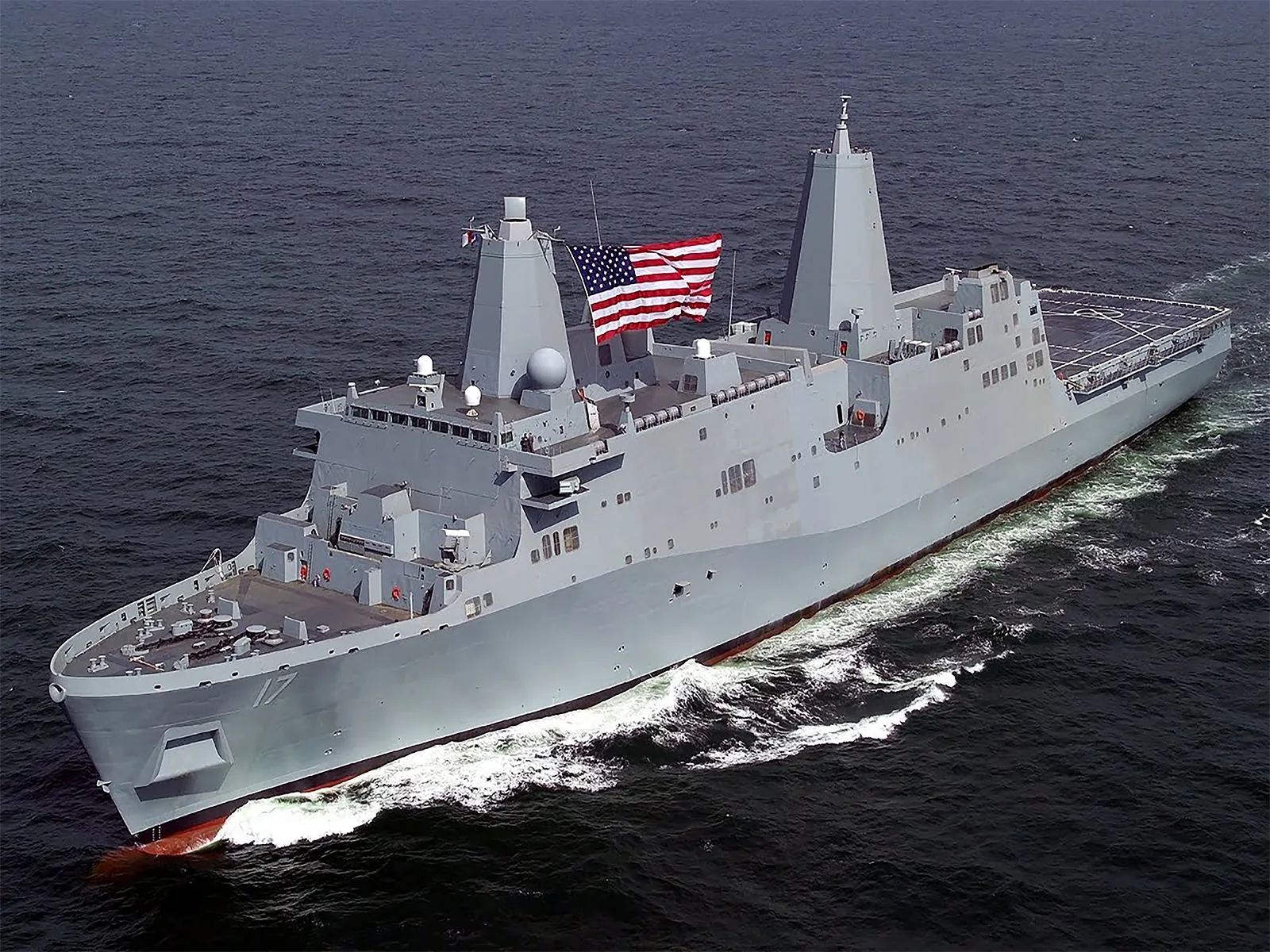
Underway and self-sufficient: a deployed ship is a floating city that has to store, chill, and serve every meal it will eat for months. Refrigeration is mission-critical, not back-of-house.
Why military-grade refrigeration is the toughest there is
Naval refrigeration is the most demanding application of cold storage on earth, because failure is not an inconvenience — it is a crew that cannot be fed. To earn a place on a ship, a unit has to survive conditions no commercial kitchen will ever see, and that hardening is precisely what makes the civilian version so reliable. Foster builds to that standard on every line.
- Shock and vibration tested — units are validated to keep running through the slamming and constant vibration of a ship at sea.
- Saltwater and corrosion resistant — materials and finishes are chosen to shrug off a salt-spray environment that eats ordinary steel.
- 26-gauge galvanized steel panels — corrugated, foamed-in-place insulation, and no wood anywhere in doors, frames, or floors to warp, rot, or harbor bacteria.
- 3/16″ aluminum diamond-plate floors — rated to 750 lbs/sqft so loaded carts and pallets never faze them.
- Redundancy and serviceability — designed so a single component failure never takes the whole box down.
That is the through-line of this whole company: the toughest refrigeration we know how to build is built for the Navy, and then offered, unchanged in spirit, to the restaurants, grocers, hospitals, and farms that also cannot afford to lose a load. You can read the full story on our marine & naval refrigeration page.
What your kitchen can learn from a warship this summer
July is the cruelest month for commercial refrigeration. Ambient heat is at its peak, holiday demand crams the boxes full, and the doors swing open all day — the exact recipe for a compressor to give out on the one weekend you cannot afford it. The Navy plans for the worst case as a matter of routine, and your kitchen can adopt the same mindset without a defense budget.
Why commercial refrigerators fail more in the heat
Commercial refrigerators fail more in summer because high ambient temperatures force the compressor and condenser to work far harder to reject heat. Every degree warmer in the room is more load on the system, and the usual culprits — dust-clogged condenser coils, blocked airflow, worn door gaskets, a unit shoved into a hot, cramped corner — all compound on the hottest days. That is also, predictably, when your business is busiest, which is why a July breakdown is so costly. The FDA requires cold-holding at 40°F or below, and any perishable food held above 40°F for more than two hours has to be thrown out.
Coolers: 34–40°F product temperature (38°F is a safe target). Freezers: -10 to 0°F. Verify with a calibrated thermometer at the warmest part of the box, never the dial — and discard perishables held above 40°F for more than two hours.
The pre-holiday cold-chain checklist
Before any big-weekend rush, run the same kind of readiness check a ship's crew runs before getting underway. A few minutes here prevents the worst kind of holiday emergency:
| Check | Why it matters in the heat |
|---|---|
| Clean the condenser coils | Dust-clogged coils are the #1 cause of summer breakdowns — they choke off heat rejection right when the load peaks. |
| Inspect door gaskets | A cracked or loose gasket bleeds cold air all day; in July that means a compressor that never stops running. |
| Clear the airflow & clearance | Keep generous space around the unit and out of direct sun so it can actually shed heat. |
| Install a temperature alarm | The Navy never trusts a single eyeball. An alarm catches a rising box at 2 a.m., before the load is lost. |
| Don't overload shelves | Packed-solid boxes block airflow and create warm pockets — exactly where food drifts out of the safe range. |
| Book preventative service | A planned quarterly service call is a fraction of the cost of an emergency one on a holiday weekend. |
For the deeper version of this, see our guides on restaurant refrigeration systems and energy-efficient commercial coolers.
The 2026 refrigerant change every buyer should know
There is one more reason 2026 is the year to get your cold storage right, though it pays to be precise about what the rules actually say. Two separate EPA actions are in play. First, a leak-management rule took effect January 1, 2026: any refrigeration circuit holding 15 lbs or more of a high-GWP refrigerant (such as R-404A, R-448A, or R-449A) must now track its charge, repair leaks above a 20% annual rate within 30 days, and keep records. Second, under the AIM Act's Technology Transitions rule, GWP installation limits phase in for new equipment — roughly 700 for new cold-storage warehouse systems (effective ~July 2026) and 1,400 for remote condensing and supermarket systems — with the stricter limits pushed out to January 1, 2032. There is no blanket January-2026 ban on installing those refrigerants; the move toward lower-GWP A2L blends and natural refrigerants such as R-290 (propane) is being driven by these phased GWP caps.
For anyone buying a walk-in this year, the takeaway is simple: a unit specified the old way can be obsolete on the day it is installed. The smart move — the future-proof move — is to buy refrigeration designed around a compliant, low-GWP refrigerant from the start, paired with high R-value insulation, EC fan motors, and digital controls that keep your energy bill down through every summer that follows. It is the same instinct the Navy applies to a 30-year ship: build it right once, so it serves for decades.
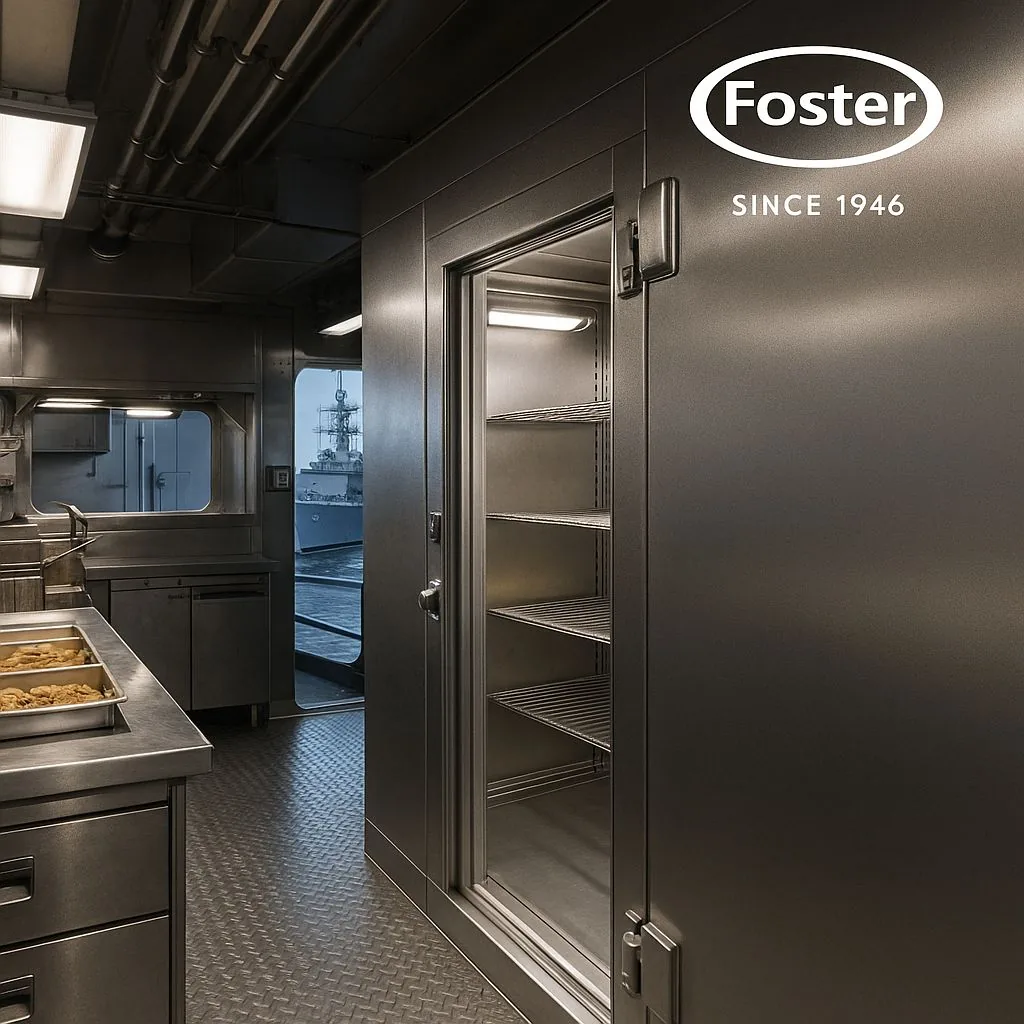
The same construction that earns a place aboard ship — sealed panels, diamond-plate floors, no wood — is what makes a Foster walk-in hold its temperature through the worst week of summer.
Built for those who serve — and for everyone they come home to
The image at the top of this page is a Navy ship coming home, sailors manning the rails, the flag streaming off the mast. It is the picture the Fourth of July is really about: people who served, returning to the country and the families they protected. Foster has spent more than 75 years making sure that, wherever those crews were stationed, the food was fresh and the freezer never quit.
That heritage is not a marketing line for us — it is the manufacturing standard. When you put a Foster walk-in in a restaurant, a grocery, a school, or a hospital, you are getting refrigeration engineered to the same uncompromising bar the Navy demanded in 1946 and still demands today. American made, in Hudson, New York, for the people who feed America.
So this Independence Day: thank you to everyone who has worn the uniform, and to the families who hold the home front. We will keep doing our part — keeping it fresh, for those who serve and everyone they serve.
Frequently Asked Questions
How does the U.S. Navy keep food fresh at sea for months?
The U.S. Navy keeps food fresh on long deployments using marine-rated walk-in coolers and freezers engineered for shock, vibration, and saltwater exposure, paired with strict cold-chain discipline. A single carrier can store millions of meals across reefer spaces held precisely between -10°F and 40°F. Redundant compressors, sealed insulated panels, and constant temperature monitoring keep the cold chain intact even in heavy seas and tropical heat, so a crew can be fed for six months without resupply.
Why do commercial refrigerators fail more in summer?
Commercial refrigerators fail more in summer because high ambient heat forces the compressor and condenser to work far harder to reject heat. Dirty condenser coils, blocked airflow, worn door gaskets, and units placed in hot, cramped spaces all compound the strain on the hottest days of the year, which is exactly when holiday demand peaks. The fix is preventative: clean coils monthly, check gaskets, keep generous clearance around the unit, and install a temperature alarm so you catch a rising box before food is lost.
What temperature should a walk-in cooler and freezer hold?
A walk-in cooler should hold a product temperature between 34°F and 40°F, with 38°F a common target that stays safely under the FDA's 41°F limit without freezing produce. A walk-in freezer should run from -10°F to 0°F. Verify with a calibrated thermometer rather than the dial, and discard any perishable food held above 40°F for more than two hours.
What is the 2026 EPA refrigerant rule for commercial refrigeration?
There are two distinct rules, not one ban. Effective January 1, 2026, an EPA leak-management rule requires any refrigeration circuit holding 15 lbs or more of a high-GWP refrigerant (such as R-404A, R-448A, or R-449A) to track its charge, repair leaks above a 20% annual rate within 30 days, and keep records. Separately, the AIM Act's Technology Transitions rule phases in GWP limits on new equipment — about 700 for new cold-storage warehouse systems (effective ~July 2026) and 1,400 for remote condensing and supermarket systems — with stricter limits delayed to January 1, 2032. So there is no blanket January-2026 install ban; when you buy a new walk-in, confirm it uses a compliant, low-GWP refrigerant (an A2L blend or natural refrigerant such as R-290) so it stays ahead of the phased limits.
Is Foster Refrigerators USA really a U.S. Navy supplier?
Yes. Foster Refrigerators USA has built refrigeration for the U.S. Navy and America's kitchens from Hudson, New York since 1946. Foster is a U.S. Navy approved supplier whose marine-rated units are tested for shock, vibration, and salt-spray, and the same military-grade construction — 26-gauge galvanized steel, foamed-in-place insulation, no wood, diamond-plate floors — carries straight into its commercial walk-in coolers and freezers.
Get your cold chain summer-ready
Spec a walk-in built to the Navy's standard and ready for the 2026 refrigerant rules — sized to your space, your temperature range, and your doors. American made in Hudson, NY since 1946.