A commercial walk-in cooler is a large, climate-controlled refrigerated room — typically held at 34–40°F — that staff can walk into to store and manage bulk perishables. The core construction is modular insulated panels: 26-gauge galvanized steel skins around foamed-in-place polyurethane insulation, sealed with tight cam-locks, paired with a matched refrigeration system and a wood-free, load-rated floor for years of stable, low-energy operation.
What is a commercial walk-in cooler?
A commercial walk-in cooler is a large, climate-controlled refrigerated room used to store perishable food and beverages at safe, regulated temperatures — typically 34°F to 40°F. Unlike a reach-in unit, a walk-in gives staff room to enter, organize, and manage bulk inventory, which makes it the central cold-storage asset in restaurants, grocery backrooms, hospitals, and food production facilities.
At Foster Refrigerators USA we have built walk-ins in Hudson, New York since 1946, and the same engineering that satisfies U.S. Navy specifications goes into every civilian unit. A walk-in is not simply a cold box; it is a precision enclosure where panel construction, insulation, floor strength, and refrigeration placement all work together to hold temperature, cut energy use, and pass health inspections year after year.
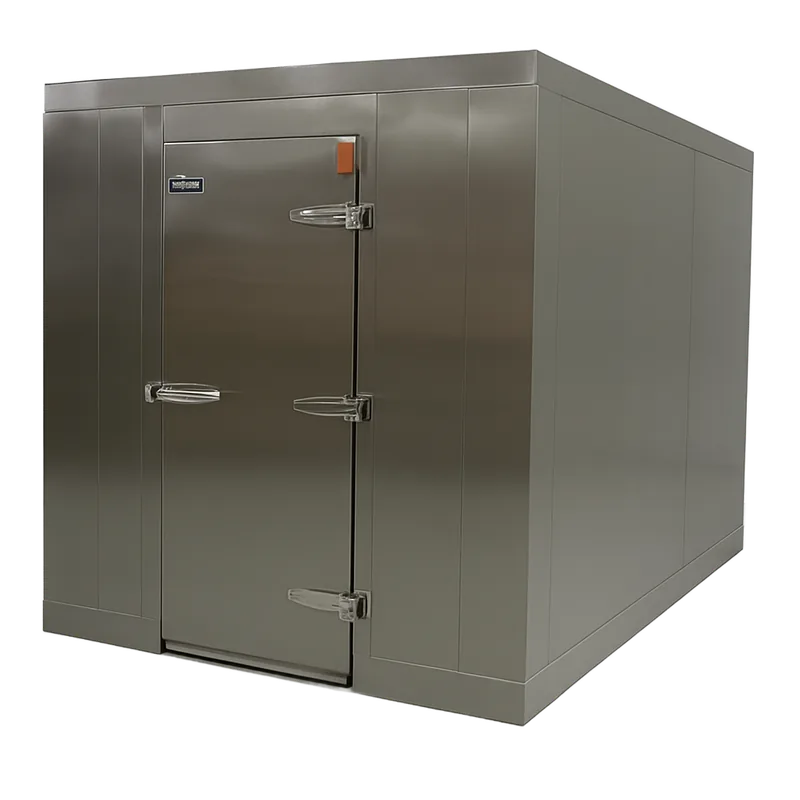
How is a Foster walk-in built?
Every Foster walk-in is assembled from modular panels with 26-gauge galvanized prepainted steel skins and a high-density foamed-in-place polyurethane core rated at roughly R-7 per inch. This sandwich construction creates an airtight, structurally rigid shell that resists heat exchange, condensation, and corrosion far longer than field-built rooms or wood-framed alternatives.
There is deliberately no wood anywhere in the doors, frames, or floors, so there is nothing to rot, swell, or harbor bacteria. The floor is a 3/16-inch aluminum diamond-plate deck rated to 750 pounds per square foot, which means pallets, hand trucks, and stacked inventory roll in without flexing or denting the panel. Naval units are tested further for shock, vibration, and saltwater exposure, and that durability standard carries straight into the commercial line.
| Panel | 26-gauge galvanized prepainted steel, corrugated finish, modular and reconfigurable |
|---|---|
| Insulation | Foamed-in-place polyurethane core — high R-value (~R-7 per inch) |
| Floor | 3/16″ aluminum diamond-plate, rated to 750 lb/ft² — no wood |
| Sizing | From 6×6 ft, expandable in 2-ft increments up to 12 ft wide, unlimited length |
| Temperature accuracy | ±1°F precision climate control |
| Warranty | 15-year panel, 1-year parts & labor, optional 5-year compressor |
| Compliance | U.S. Navy approved, NSF certified, ENERGY STAR, ISO 9001/14001 |
Why does insulation and temperature accuracy matter?
Insulation is the core of a reliable walk-in: it holds a steady internal temperature, lowers energy consumption, and extends the life of the refrigeration system. Foster's foamed-in-place polyurethane is injected into the panel cavity so it expands and bonds to both steel skins, eliminating the gaps and seams that let warm air leak into field-assembled rooms.
That sealed envelope is what lets Foster hold internal temperature to ±1°F. Tight accuracy means faster cooling recovery after the door opens, lower utility bills from reduced heat exchange, and a longer buffer during a power outage. For an operator, it also translates directly into energy efficiency and dependable compliance with FDA and USDA cold-holding requirements — perishable stock simply never drifts out of its safe band.
How small or large can a walk-in cooler be?
A Foster walk-in starts at a compact 6×6 foot footprint and expands in 2-foot increments up to 12 feet wide, with no practical limit on length. That modularity means the same panel system fits a single-unit deli, a mid-size cafe, or a grocery backroom and high-volume commissary — without overpaying for capacity you will never use.
Because the panels lock together as a kit, door placement and swing direction are specified to suit your traffic flow, and a single enclosure can be split into a combination cooler/freezer. Common layouts range from a 6×6 unit for tight kitchens, to 8×10 for mid-size restaurants, up to 10×20 and larger for production operations. Our build-and-quote tool walks you through size, temperature range, and door configuration step by step.
Where does the refrigeration go?
Foster offers top-mount, penthouse, and remote refrigeration so the cooling system fits the building rather than forcing the building to fit the cooler. A top-mounted condensing unit is the simplest and most compact option; a penthouse system sits cleanly on the roof of the box; and a remote system relocates the compressor and condenser away from the walk-in entirely for quieter front-of-house environments.
This flexibility is what lets a walk-in install indoors beside a prep line, in back-of-house storage, on a rooftop to save floor space, or aboard a vessel. The same configurability that serves restaurants also equips fishing boats, ferries, cruise ships, and U.S. Navy ships, where Foster units are built to marine-rated standards for shock, vibration, and saltwater exposure.
What warranty and certifications back a Foster walk-in?
A walk-in cooler is a multi-decade investment, and Foster's coverage reflects that: a 15-year warranty on panels for insulation performance and structural integrity, a 1-year warranty on standard refrigeration parts and labor, and an optional 5-year extended warranty on compressors. That protection guards against delamination, panel corrosion, manufacturing defects, and cooling-system failure.
Behind the warranty sit the certifications that matter for commercial buyers. Foster is a U.S. Navy approved supplier, builds to NSF food-safety standards, manufactures ENERGY STAR qualified equipment, and operates under ISO 9001 and 14001 quality and environmental systems. Paired with routine maintenance — clean coils, intact door seals, clear drain lines — a Foster walk-in is engineered to run well past 20 years with minimal performance loss.
Foster walk-ins combine 26-gauge galvanized steel, high-R-value foamed-in-place insulation, and a 750 lb/ft² diamond-plate floor with ±1°F temperature control — backed by a 15-year panel warranty and built in the USA since 1946.
Frequently Asked Questions
How accurate is the temperature control on a Foster walk-in?
Foster walk-in coolers hold internal temperature to within ±1°F. That precision keeps perishable inventory inside the 34°F to 40°F food-safe band and supports FDA and USDA compliance even after frequent door openings.
What are Foster walk-in panels made of?
Foster panels use 26-gauge galvanized prepainted steel skins bonded to a core of high-density foamed-in-place polyurethane insulation rated at roughly R-7 per inch. There is no wood in the doors, frames, or floors, which eliminates rot and warping.
How small or large can a walk-in cooler be?
Foster walk-ins start at a 6×6 foot footprint and expand in 2-foot increments up to 12 feet wide, with unlimited length. Door placement, swing direction, and combination cooler/freezer layouts are all configurable to your space.
What warranty comes with a Foster walk-in?
Every Foster walk-in carries a 15-year warranty on panels covering insulation and structural integrity, a 1-year warranty on standard refrigeration parts and labor, and an optional 5-year extended warranty on compressors.
Where can a Foster walk-in cooler be installed?
Foster walk-ins install indoors near prep lines or back-of-house, and outdoors or on rooftops with weather caps. Refrigeration can be top-mounted, penthouse, or remote, so units fit restaurants, grocery backrooms, and even marine and U.S. Navy vessels.
Ready to spec your walk-in?
Configure size, temperature range, and door layout, or talk through your project with our team in Hudson, NY. Built to Navy standards, made in the USA since 1946.